


The presentations from Day 2 of the Glassman Latin America conference are now available.
Glassman Latin America took place on the 20th and 21st of May at the at the Expo Santa Fe Mexico.
On Day 2, the conference featured talks on recycling, blank temperature control, artificial intelligence, pneumatic solutions, and refractory innovation.
Please see the below for the presentations from Day 2.
THURSDAY 21 MAY
Refractarios Especiales León - Closing the Loop: Industrial Recycling of High-Alumina Refractories in the Mexican Glass Industry.

Pictured: Gloria Oswelia León Álvarez, Founder and General Director at Refractarios Especiales León.
Second speaker (not pictured): Miguel Ángel Espinosa León, Sales Manager at Refractarios Especiales León.
Abstract: This session will present the industrial development of high-recycled refractory materials within the Mexican glass industry. Refractarios Especiales León, founded by a chemical engineer from ESIQIE-IPN to support the Mexican glass industry, has long explored practical ways to incorporate recycled refractory materials into industrial production. In 2020, global uncertainty during the COVID-19 pandemic and limited raw-material inventories accelerated efforts to recycle production returns directly into new refractory pieces. Unlike common industry practice, where recycled refractories are typically downgraded into secondary materials, this project explores the reuse of refractory returns in high-performance products. The discussion will address the milling strategy, the environmental implications, and the ongoing industrial trials that are paving the way toward broader technical validation.
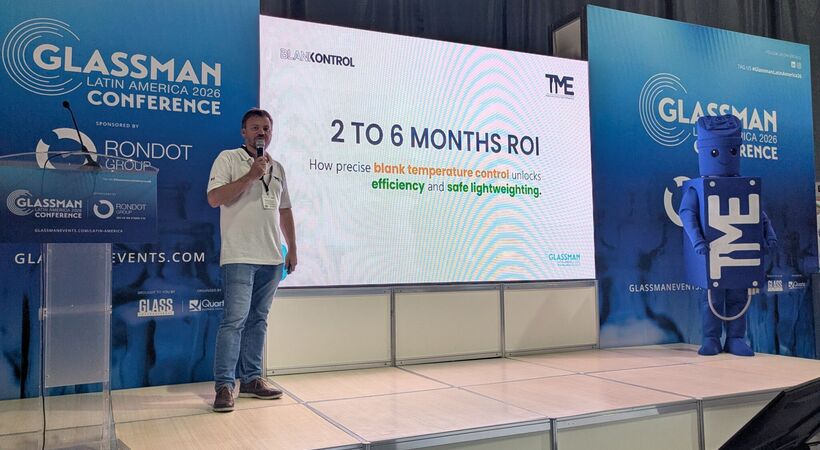
TME Engineering - Blankontrol: From 6 to 2 months ROI – How precise blank temperature control unlocks safe lightweighting and maximum productivity.

Raphaël Malvezin, CEO at TME Engineering.
Abstract: In Mexico's competitive container glass market, where yield, defect reduction, and fast payback are critical, TME Engineering’s Blankontrol delivers outstanding results. By providing real-time, non-contact temperature measurement of blanks and plungers with ±2°C accuracy, Blankontrol ensures homogeneous glass distribution at the blank side.
Without lightweighting, the typical ROI is reached in six months, thanks to reduced thermal defects, faster start-ups, and improved process stability. When enabling safe lightweighting, the same system accelerates ROI to just two months through significant savings in glass, energy, and transportation costs, while maintaining or improving bottle strength and line efficiency.
Drawing from industrial deployments, this presentation shares concrete process data and quantifies Blankontrol’s combined impact on yield and profitability for Latin American plants.
AMETEK Land - From Fire to Insight: AI Transforming Glass Furnace Operations with NIRB technology.

Philippe Kerbois, Global Industry Manager – Metal and Glass at AMETEK Land.
Abstract: Glass furnace operations demand precise temperature control, efficient energy utilisation, and rigorous quality assurance to maintain production efficiency and meet environmental standards. This paper introduces an innovative AI module integrated with AMETEK Land Image Pro software, enhancing its thermal imaging capabilities with advanced analytics and manual decision support. The proposed module leverages machine learning and computer vision to optimise furnace performance, improve glass quality, and enable predictive maintenance. Through real-world data and simulations, we demonstrate how the AI module achieves energy efficiency, defect reduction, and operational cost savings. This advancement represents a paradigm shift in glass manufacturing, aligning with Industry 4.0 principles.
Pneumofore - Pressure Points: Hidden Savings in Pneumatic Solutions.

Andrés Marcelo Gómez Ramones, Latin America Area Sales Manager for Pneumofore.
Abstract: In hollow glass production, compressed air and vacuum systems are process-critical utilities that operate continuously, yet often receive insufficient attention. When properly specified, they remain invisible; but when they are poorly designed or sized, they become a recurring source of downtime, excessive energy consumption, and avoidable maintenance costs.
Equipment selection driven primarily by initial acquisition price, rather than actual plant requirements, can result in years of inefficiencies. This session focuses on how to select equipment aligned with real operational needs, and demonstrates how informed purchasing choices translate into long-term cost savings, high reliability, and greater process stability.
RHI Magnesita - Supporting Glass Melting Sustainability with Refractory Innovation.
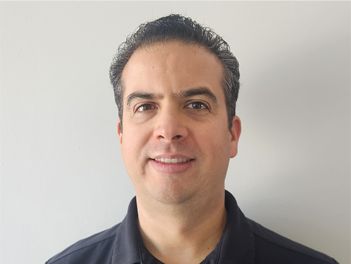
Ignacio Ramírez Lozano, Technical Marketing Manager at RHI Magnesita.
Abstract: Glass manufacturers have traditionally aimed at energy optimisation due to the melting process intense energy requirement nature. In recent years, CO2 reduction has gained importance and adds complexity to the manufacturer´s objectives.
In this paper two state-of-the-art lining concepts offered by RHI Magnesita will be described as alternatives that contribute directly towards glass melting sustainability.
The INNOREG regenerator concept is a proven tool that offers a customised design aligned to the specific furnace requirements. Recent high-efficiency checker shape developments provide new possibilities to optimise the regenerator layout.
The second concept, emissivity-enhanced silica crowns, has on its core the honeycomb shape, which outperforms the traditional flat hot face due to the increased heat exchange area and emissivity coefficient.
