


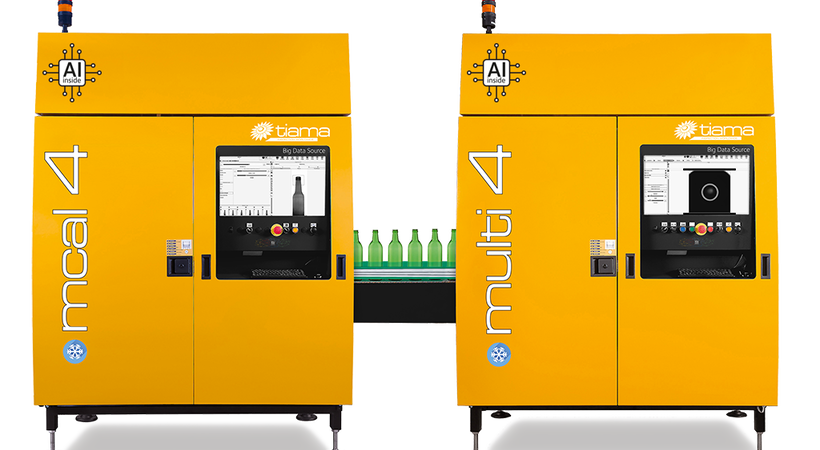
Victor Outrbon* presents MCAL 4 AI, a sidewall inspection machine based on Artificial Intelligence (AI) that decreases false rejection rates and reduces CO2 emissions.
Even though Artificial Intelligence (AI) has highlighted promising benefits in the image processing business for quite some time, it is only over the past months that it really has started to introduce game-changing capabilities to the glass-making industry.
Back in January this year, Tiama released the MCAL 4 AI (Pic 1). This updated version of the sidewall machine now runs high-speed production inspection with AI, switching on a long list of benefits for today’s and tomorrow’s glassmaking process.
AI networks
Thanks to its large fleet of sidewall machines running globally, Tiama has generated trillions of images of glass containers over the past years.
In close partnership with glassmakers, it allowed to nurture and generate highly performing AI neuronal networks.
This dataset now being wide enough, Tiama offers every hollow glassmaker the possibility to run their inspection with it on sidewall inspection.
Not only are these AI networks now capable of precise defects recognition, but they also drop the amount of false reject traditional inspection systems can generate, and this is just the start.
Identifying defects
Over the past decades, machine manufacturers developed multi-criteria algorithms based on surfaces, lengths, shapes, thickness or orientation to ensure advanced defect detection.
However, the classification provided with these algorithms used to be difficult for glassmakers to interpret, not providing meaningful information on the nature and the root cause of the defects.
This had to do with the fact that these algorithms didn’t know what defect they were detecting, but only knew if they were matching the preset list of criteria.
Now with AI, a clear identification of the defect name and criticality is made possible. As of today, it can identify a wide list of defect classes like birdswings, wings, open blisters, checks, inclusions or blisters.
These defects occurrences and their associated images are stored and accessible either on the machine or under Tiama ECO-system, the web-based tool from Tiama gathering all data from Tiama machines and sensors.
With such a tool, practices like defect root cause analysis per mould, images sharing with hot-end and lines comparison is made easy and remotely.
Maximising sellable ware
A known side effect of running advanced defect detection to comply with demanding quality goals is to generate a loss of acceptable ware.
Commonly defined as false rejection, this share of total rejection can add up to thousands of containers conveyed back to the furnace.
By learning images characteristics that would contribute to false reject generation such as shadows, black spots, mould seams or engravings, AI is able to make a difference between actual defects and what can be accepted.
Then, AI can decide to keep that sellable ware on the conveyor instead of sending it back to the cullet conveyor.
For instance, in production conditions on an existing beer line running with MCAL 4 AI, a significant share of 15% rejects were generated by acceptable elements such as black spots or shadows in the images.
On that cold-end inspection line running at 300 containers per minute with an average of 3% actual defect rate, this results in 660,000 containers per year that could have been sold without getting melted again.
In other words, 0.45% of pack-to-melt gain is achieved. For higher speed inspection lines, even better gain can be obtained as AI brings no speed limitation.
GHG emission reduction
With an average of 0.4 tons of CO2 emitted per ton of melted glass for conventional furnaces and considering that all-year-round produced beer model with a weight of 215 grams, the emission of 57 tons of CO2 can be avoided as re-melting and annealing process is avoided for the saved containers.
With a limited investment accessible without involving a full furnace change and line refurbishment, it provides one of the best CO2 footprint gain per $ invested, especially as every existing sidewall and base & finish machine can be upgraded to an AI-enabled one.
A smooth transition to AI
As the revolution brought by AI within inspection machines will change the way defect detection is processed in plants, Tiama has made it easy for operators to run.
Only two parameters are required to be set. This reduces operators’ job complexity and drastically simplifies the way standard algorithms used to work.
As experience and knowledge is scarce in glass plants globally, AI settings on machines have been made so it doesn’t require any specific knowledge to use. To smoothly adapt inspection quality standard for each job change settings, the MCAL 4 AI can run with or without the addition of AI.
In addition, Tiama continuously improves AI performance and offers the possibility to upload new AI neuronal networks updates directly in the machines, so they benefit from the latest performance advancements, without requiring any hardware change or human intervention.
Future-proof hardware
Of course, sidewall inspection is just one of the contributions of AI in inspection machines.
Tiama now equips every MCAL (sidewall inspection) but also every MULTI (base and finish) machines with AI-ready technology, so they are able to run today’s and tomorrow’s AI live inspection capabilities on camera-based type of inspection (sidewall, mould number, base, thread defects).
Furthermore, Tiama’s close-loop approach called YOUniverse multiplies AI benefits for glassmakers as neuronal networks will also run simultaneously in both cold-end and hot-end systems.
*Cold End Product Manager, Tiama,
Lyon, France
https://www.tiama.com/

