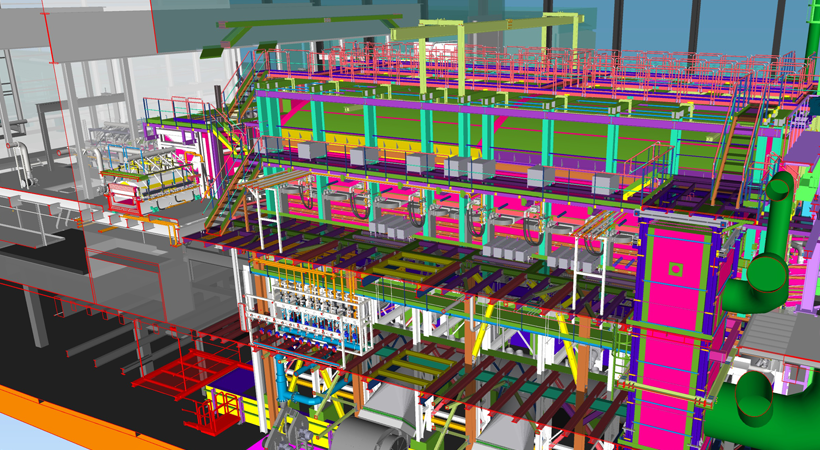
Giorgio Minestrini, Chief Project Officer at Stara Glass, highlights how digital tools can revolutionise the lifecycle of design, communication, and plant construction.
At Stara Glass, the Technical Department is the beating heart of engineering advancement.
Established in the 1990s with an initial focus on refractory design, it gradually expanded its expertise, consolidating knowledge between 2000 and 2010 in the areas of steel structures, heat recovery systems, and special equipment.
This evolution led the department to manage entire projects using the Engineering, Procurement and Construction (EPC) model, in close collaboration with clients through digital, collaborative platforms.
A major turning point came with the introduction of laser scanning technology, enabling accurate surveys and reducing the risk of clashes between existing structures and new installations in revamping projects.
Since 2019, Stara Glass transformed its technical processes through the adoption of Building Information Modelling (BIM) methodology.
BIM is not just a tool. It is capable of revolutionising the lifecycle of design, communication, and plant construction.
Each BIM model acts as a digital container full of information: beyond 3D representation, it incorporates functional, technical, economic, and management data for every component of the plant, from beams to supports, and from systems to accessories.
Benefits
By using modelling software like Tekla Structures and collaborative platforms such as Trimble Connect, design control occurs in real time with maximum transparency. Both internal and external professionals work in unison, supported by an automated notification system that constantly updates shared information.
Among the most notable solutions is the use of numerical control (NC) files for automatic cutting of metal components and integration with augmented reality tools.
Through QR codes associated with physical elements, users can access technical drawings, assembly diagrams, and operational instructions in real time using tablets or augmented reality (AR) headsets.
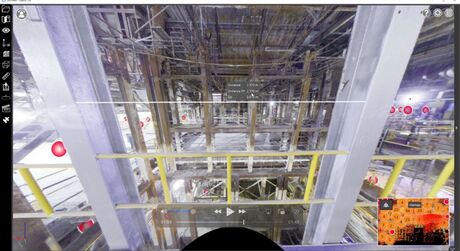
Simultaneously, the creation of a digital twin (Pic 1), a virtual replica of a physical plant, opens new possibilities for predictive maintenance, staff training, workplace safety, and continuous monitoring, thanks to integration with sensors and IoT devices.
In the field of plant engineering, BIM also proves to be a valuable aid for less experienced operators, who can interact with the system through simple, context-sensitive interfaces.
Pic 1 – A digital twin.
Sensors attached to valves, bolts, and other critical components can detect mechanical anomalies or potential malfunctions in real time, contributing to greater safety and reduced errors.
Digital transformation
The Technical Department is made up of seven specialised engineers, each capable of managing complex projects and supporting Project Managers in the role of Project Engineer.
The structure is backed by a solid network of external partners, ensuring flexibility and operational capacity even during the most critical phases of a project.
During large EPC refurbishments or more complex contracts, Stara Glass co-ordinates hundreds of technicians and suppliers, overseeing every stage.
One of the most valued capabilities by clients and stakeholders is the ability to develop tailor-made engineering solutions, even in constrained environments where existing structures cannot be altered.
In such cases, laser scanning and the close collaboration between designers and site managers are crucial from the preliminary stages to ensure optimal assembly planning.

Laura Trichilo (Pic 2), a BIM Specialist with strong structural expertise, plays a central role in the company's digital transformation.
Her contributions have been instrumental in implementing BIM in complex projects, from 3D modelling to managing data in shared environments and co-ordinating clash detection.
She said: “The strength of BIM lies in its ability to prevent problems before they even arise - it is a tool for design safety.”
Her approach has transformed BIM into a strategic vision for the entire company.
In line with European standard EN ISO 19650 and the Italian UNI 11337, Stara Glass has embarked on a certification journey.
Pic 2 - Laura Trichilo, BIM Specialist at Stara Glass.
By the first half of 2026, it aims to qualify 50% of its technical team as BIM Co-ordinators and to train Stara Tech colleagues as BIM Specialists.
Beyond traditional 3D, BIM at Stara Glass is moving toward advanced dimensions: 4D - time management; 5D - cost analysis; 6D - sustainability and lifecycle; and 7D - facility management and maintenance.
In this way, the digital model becomes a dynamic, evolving, and interactive tool, delivering tangible and measurable benefits to the end customer throughout every phase of the project.