


AGC Glass Europe has reported its 2025 sustainability figures.
The company previously set out a carbon reduction roadmap to achieve the AGC Group’s sustainability objectives.
The group aims to reduce the company's carbon footprint by 30% in 2030 and achieve net zero carbon by 2050.
It monitors its carbon footprint yearly and is estimated to have a carbon footprint of 2.4 million tonnes of CO2 in 2025.
AGC Glass Europe has implemented several initiatives to try to improve sustainability.
Renewable projects
AGC has invested in renewable and low-carbon electricity projects to reduce its reliance on grid electricity and minimise associated CO2 emissions.
This includes investments in power purchase agreements and the installation of wind turbines, photovoltaic panels, cogeneration plants and heat recovery systems at its sites.
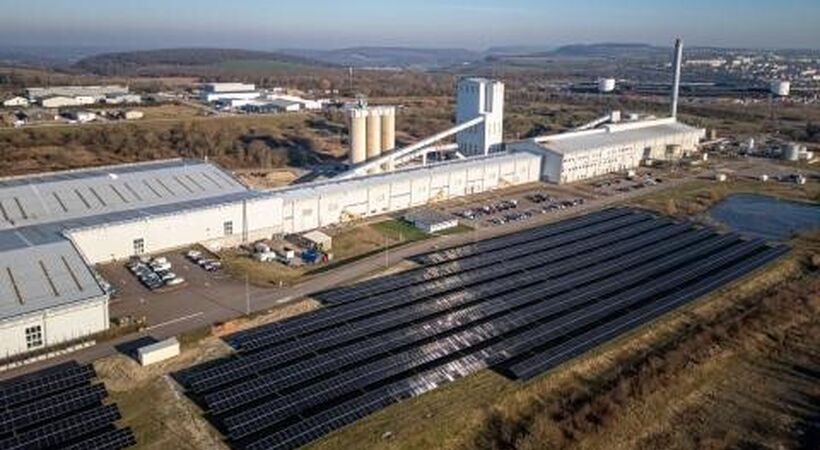
The company’s latest project was the installation of photovoltaic power plants at its site in Seignbouse, France.
The first plant, with 2.7 MWp, was installed in 2024, with a second following in 2026.
AGC also uses Guarantees of Origin (GOs) for various sites, aiming for transparency and traceability in its renewable and low-carbon energy sourcing.
Due to these initiatives, AGC successfully covered 65% of its electricity consumption with low-carbon sources in 2025, surpassing the 50% milestone for the first time.
Glass recycling
In 2025, the company recycled approximately 750,000 tonnes of cullet, saving around 900,000 tonnes of raw materials and approximately 500,000 tonnes of CO2 emissions (direct & indirect).
Over 180,000 tonnes of this volume came from pre- and post-consumer sources collected via the company’s Recycle Glass network, its service for collecting flat glass waste from industrial losses and end-of-life projects.
The collected waste glass is recycled and remelted into new, more sustainable, flat glass production.
In 2025, AGC Recycle Glass announced a partnership with Solar Materials to advance on PV flat glass circularity.
In May 2026, it announced a collaboration with Reiling to accelerate automotive circularity with a breakthrough in windshield Flat-to-Flat recycling.
Both partnerships aim to improve the circularity of glass recycling and sustainability overall.
Volta
In June, AGC announced the one-year anniversary of its Volta hybrid pilot furnace.
The furnace successfully demonstrated hybrid melting for flat glass, with the product’s energy consumption, temperature control and float glass quality confirmed across a wide range of cullet ratios and pull rates.
The project was a collaboration with Saint-Gobain and reported a 66% reduction in fossil fuel consumption and a 71% reduction in Scope 1+3 CO₂ emissions.
Low-carbon glass
Since 2022, AGC Glass Europe has produced low-carbon float glass containing less embodied carbon.
The glass contains 4.8 kg CO₂ eq./m² (4mm), and contains more than 60% recycled content.
It is used in glazing products such as safety glass, insulation glass, solar control glass and fire-resistant glass.

