Researchers at the Freiberg University of Mining and Technology in Germany have developed an all-electric melting process for the production of amber glass on a laboratory scale.
Currently, the production of amber glass in Germany emits around 0.58 million tonnes of CO2 per year.
By heating the glass melting tank with electricity instead of natural gas, approximately 86% of CO2 emissions could be saved.
This corresponds to the annual CO2 emissions of around 77,000 households.
Brown jars are mainly used for packaging medicines and light-sensitive foods.
Traditionally, a brown colour carrier – in this case sodium sulphate, iron oxide, and a reducing agent – is added to the glass batch.
It is then melted in a gas-heated tanks at temperatures reaching 1,500°C.
Heating the furnace electrically is not yet industrially feasible – the main challenge lies in maintain the stability of the colour and the batch.
Pilot project
Using an all-electric pilot plant, a team from the Institute of Glass Science and Technology at the university succeeded in identifying the factors that previously prevented the colour carrier in the electric glass melting tank from reliably producing the brown colour.
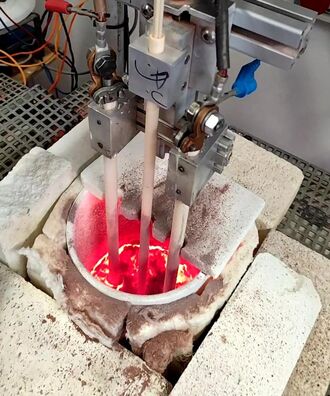
The plant uses the cold-top process, in which an insulating layer of cool mixture lies on the top of the melt like a lid.
Project Manager Dr Khaled Al Hamdan said: “Although this saves a huge amount of energy, it makes it much more complicated to precisely control the chemical reactions and the escape of gases inside.”
A special composition of colour carrier, reducing agent and refining agent proved to be particularly suitable for the reliable formation of the brown colour body.
Dr Al Hamdan continued: “The ratio of the mixture additions differs significantly from traditional melting processes.
“By modifying the proportions of colour and reducing agent as well as the temperature profile and the top of the batch, we were able to overcome these obstacles.”
Image copyright: The Freiberg University of Mining and Technology (TU Bergakademie Freiberg, or TUBAF).
In the laboratory, the team was able to prove that the production of amber glass in the all-electric melting system is reliable and of high quality.
In addition, the amount of colour or sulphur carrier can be halved.
The project was funded by the Federal Ministry for Economic Affairs and Energy from January 2023 to January 2026, and is now being tested with industrial partners.