


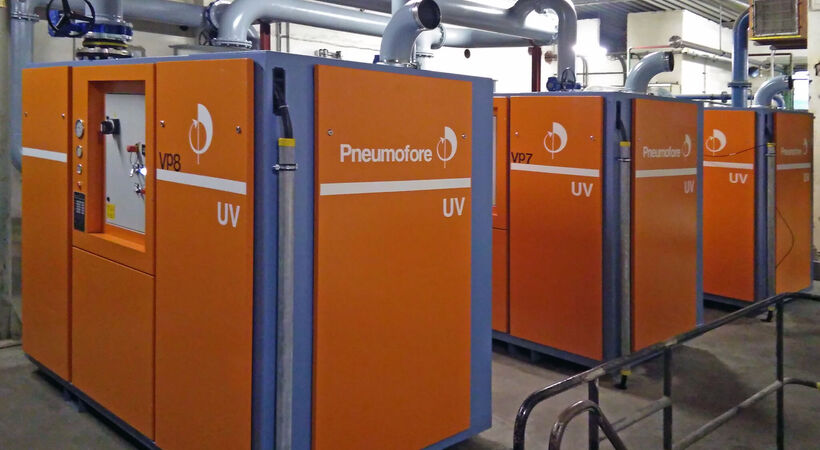
Ardagh Group has joined forces with Pneumofore to work at its facility in Nienburg, Germany.
The two companies designed a vacuum system to recover waste heat during container glass manufacturing.
The system aims to improve overall plant efficiency.
The initial installation dates back to 2016, when two UV50 rotary vane vacuum pumps were commissioned, followed by a third unit in 2017.
The system was engineered with careful attention to detail.
It included correctly dimensioned pipelines, an efficient filtration concept including a DVF demister, and the integration of a Variable Speed Drive (VSD) on one unit to adapt capacity to fluctuating production demands in hollow glass manufacturing.
Pneumofore explained that properly dimensioned piping minimises pressure losses and ensures rapid compensation of process fluctuations.
After operational success in hollow glass manufacturing, the vacuum system was expanded in 2022.
Three additional UV50 units were developed: two fixed speed units and a third with VSD, this time equipped with integrated heat recovery (HR) technology.
The system evolution reflects a broader shift in industrial awareness.
Companies recognise that vacuum systems, much like compressed air systems, dissipate a significant share of their input energy in the form of heat.
While the installed power of vacuum pumps is typically lower than that of air compressors, the potential for energy recovery remains relevant.
By capturing and reusing thermal energy, glass manufacturers can reduce both primary energy demand and associated CO₂ emissions.
Such measures are increasingly supported by public incentive schemes but equally driven by the industry’s own commitment to sustainable production.
Furthermore, heat recovery systems contribute to measurable cost savings over relatively short payback periods.
Currently, six UV50 vacuum pumps operate at the Nienburg plant, supporting IS machines in the moulding of hollow glass containers.
Stable and precisely controlled vacuum levels, ensured through variable speed operation, enable higher production speeds while reducing defect rates and material waste.
Long-term reliability
The original units installed in 2016 have each accumulated more than 8,000 operating hours per year under continuous three-shift conditions, maintaining their initial efficiency without requiring an air-end overhaul.
This is achieved through consistent preventive maintenance using genuine spare parts, underscoring the importance of lifecycle-oriented system management.
The case of Nienburg illustrates a fundamental principle for modern glass production: efficiency gains are no longer limited to primary processes.
Auxiliary systems, when properly engineered and enhanced with technologies such as heat recovery, become strategic contributors to both sustainability and competitiveness.
