


“The UK glass industry contributes £2.4 billion to the economy and employs over 6,000 people directly, as well as 100,000 indirectly.
Each year the sector produces 3 million tonnes of glass in the UK with about 2.2 million tonnes of that for container use and 0.8 million tonnes for flat glass and wool.
Pressure
Our glass industry is under pressure from three forces, all at play simultaneously:
1) the pressure to reach net zero carbon emissions and the efforts and finances it will take to reach this position, alongside the uncertainly of the economic outlook for the UK
2) the threat of new policy landscape shaping the outlook for food and beverage packaging, currently in play and future iterations to come
3) current trade policies enabling imported goods to come directly onto the UK market at a lower cost, with a significant benefit from cost competitiveness of other global energy markets over and above our own highly-priced energy system in the UK.
As a country we need circular packaging that is chemically inert for our food and beverages. A key point is ‘chemically inert’ - that is what glass containers bring to food and beverage packaging, no other material does this.
Let us retain the manufacturing capability that we have in the UK and not outsource and allow imports with high carbon footprints from countries such as China, India and Turkey to take precedence in our markets over locally manufactured goods.
Glass manufacturing can become extremely low carbon, in this country we have the technologies, and we have the fuel potentials available to support all glass manufacturers in all sectors.
However we’re all competing for investment.
I’ve seen this first-hand how decisions are made while employed by Ardagh, which has the first next-generation electric hybrid furnace that has achieved 64% reduced carbon emissions to date, and which has been running for 2.5 years.
This furnace went to Germany and not the UK. Why? Because the funding was there from the government, because the infrastructure was already in place – and the fact the EU's energy markets enable lower costing structures, while the investing platform and the economic outlooks are more stable there than the UK.
Strategy
If the UK wants to lead industrial decarbonisation and reach its net zero targets, while still retaining the fabric of British manufactured goods, we need to meet this ambition.
This means we need a UK-wide industrial decarbonisation strategy that includes glass.
We need funding that matches EU levels, so investment flows here and not elsewhere, we need support for innovation and fuel switching options.
We need access to affordable low carbon energy and upgraded grid connections - electrification for the glass sector is entirely possible and has been proven.
It is not cheap, we need support for capital investment and ongoing inflated operating costs, we need confidence that if UK manufacturers are to invest in electrification the government will back us and not leave us exposed to unfair competition.
We need somewhere that will ensure stability for investment and remove an uncertain economic outlook on the glass sector formed by policy changes.
Competition
This brings me to trade. Right now, UK manufacturers are competing with imports that are produced using sources of cheap gas.
Sometimes these are also heavily subsidised to support the local economic growth of exporting nations.
This is not a level playing field, we as an industry are not asking for protectionism we're just asking for fairness, for trade policies that reflect the UK's industrial strategy and values that protect our own UK manufactured goods.
Packaging regulation
For the container sector, in addition to the support for energy electrification and the import issue I’ve already raised, we also need to fix the very systems and policies that govern the recycling and packaging systems among us today.
A reform of the Packaging Recovery Note (PRN) system. so we keep recycled glass cullet in the UK. is vital for circularity and decarbonisation. These discussions are ongoing, but we must ensure changes to the current system to ensure that all our collected glass waste remains within the UK and is prioritised for remelt activities where fit to do so.
We need alignment of deposit return schemes across the UK, currently we face a fragmented position with the devolved nations all attempting to undertake isolated approaches and even these contradict and undermine the recent changes made by PePR here in England.
If we are to deploy deposit return systems, we ask for it not to be disconnected across the nations.
We need to ensure consistency, we need to coordinate the same policies across the administrations and certainly not increase further costs onto suppliers and consumers with a disjointed and disconnected system that in isolation alongside PePR will do just that.
All container manufacturers have felt the brunt of the PePR scheme in play this year.
In theory it is a system designed to support long term circularity and sustainability, a system that should bring about more attractive and robust material collection and sort and recycle approaches.
Threat
However right now due to inadequacies within the system calculations, it is incentivising a shift to lighter, less sustainable materials that are not circular in nature.
This is a huge threat to the glass container sector, one that can have irreversible consequences if it is not revisited.
The inaccurate fee calculation has led to an inaccurate value assigned to the very material that this system should support and protect.
We suggest that the next iteration of this scheme is the one opportunity we have to get this right and ensure the correct measures are being applied, to ensure costings are relevant to the circular value of the collection and reprocessing systems that the fee is there to support.
Growth
UK manufacturers are ready to invest, they’re ready to innovate but we need government to meet us on this pathway, making supported changes to the policy landscape in cooperation with the manufacturing sector within the wider UK industrial decarbonisation strategy.
We need fair import regulations to balance the markets because, if we get this right, UK glass manufacturing won’t just hit net zero, it will be competitive in our own domestic markets as well as on global markets.
It will create growth in the sector, will lead in waste management circularity and industrial decarbonisation, while maintaining a substantial contribution to the UK’s GDP growth.”
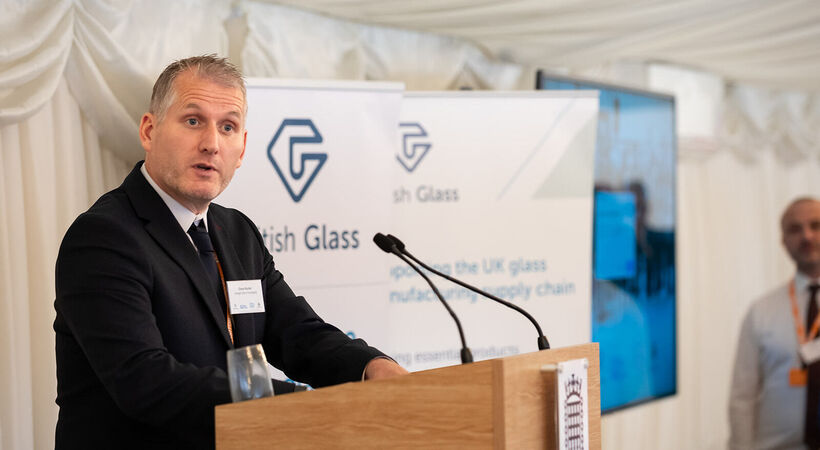
*Mr Butler was speaking at an event organised by the UK Glass & Glazing Collective. The event showcased the critical role of glass and brought together MPs, industry leaders, and policymakers, all united by a shared ambition to unlock the full potential of the UK glass and glazing sector.

