


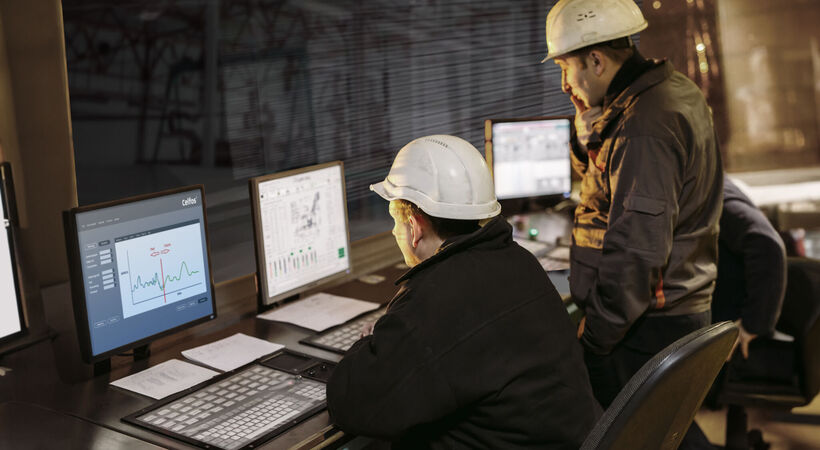
CelSian has developed a system that can predict the future quality of glass.
The independent glass company combined process data, AI, and Computational Fluid Dynamics (CFD)-based insights to deliver predictive capabilities in daily furnace operations.
As glass producers face increasing pressure to improve yield and reduce costs while maintaining consistent product quality, anticipating process disruptions is becoming essential.
In glass melting, quality is influenced by process conditions that develop over time inside the furnace.
The impact of process conditions often becomes visible only later, in the form of defects such as cords, seeds and bubbles.
The delay makes it difficult to connect current operating conditions with final product quality and limits the ability to act in time.
With Celfos, CelSian introduces a forward-looking approach by predicting glass quality up to 48 hours in advance.
Using furnace data such as temperatures and process settings, the system identifies patterns that influence defect formation and links present conditions to future outcomes.
This enables operators to anticipate instability and take action before defects occur.
The system builds on a combination of AI and CelSian’s CFD modeling software, GTM-X.
By integrating data-driven learning with process understanding, it interprets furnace behavior that reflects both real-time operation and the underlying process dynamics.
This allows predictions to remain relevant under varying operating conditions.
Celfos also continuously updates its predictions using real-time data, providing operators with an evolving view of expected quality and supporting more timely and informed decision-making.
The availability of historical predictions alongside actual outcomes further helps to assess performance and build confidence in the system.
Now Celfos is moving beyond concept into a proven industrial application.
The system has now been implemented across multiple production sites and applied to different furnace types, including container, float, and fiberglass operations.
In these environments, it is used to monitor and predict defect formation under real production conditions, where it has demonstrated strong prediction accuracy.
The platform has also been developed to integrate with existing plant infrastructures, supporting connections to a range of data systems including OPC, SQL, PI, PostgreSQL, and Snowflake.
