


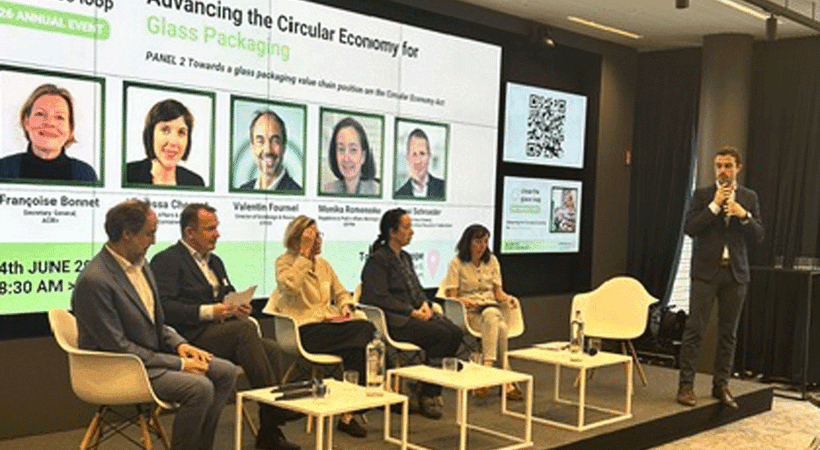
Close the Glass Loop held its annual event in Brussels this week.
Representatives from the European glass industry, EU policymakers and waste management and recycling companies gathered at the Townhall Europe in Brussels for the event yesterday (Thursday June 4).
The action platform aims to achieve 90% glass packaging collection for recycling by 2030 in the EU.
The all-day event focused on sustainability and the circular economy, and included discussions of the Circular Economy Act, the PPWR implementation, and the EU's Clean Industrial Deal.
Glass recycling
The event started with opening remarks from Jean-Paul Judson, coordinator of Close the Glass Loop, who chaired the talks throughout the day.
Mr Judson was followed by a short video clip from Letizia Moratti, Member of the European Parliament (EPP/IT), who could not attend in person.
Letizia Moratti briefly discussed the unique importance of glass regarding recycling, with its ability to be recycled infinitely without loss of quality.
She stressed the importance of scaling the circular economy, while ensuring the approach connects the single market with climate and environmental policy.
Industrial competitiveness
The first panel discussion of the day ran from 9:15 to 10:30, and featured Stefano Cassano, Corporate Director of Production Materials Purchasing at Verallia and Sylvain Hourquebie, President for Sibelco Green Solutions France.
The panel also featured Emmanuelle Maire, Head of Unit for Circular Economy, Sustainable Production and Consumption for the European Commission, Francesca Stevens, Secretary General at EUROPEN, and Paolo Campanella, Secretary General at FEAD.
The discussion centred on the relationship between industrial competitiveness and the circular economy, with panellists arguing that Europe cannot achieve its recycling and sustainability goals without maintaining a strong manufacturing base.
The speakers highlighted challenges including high energy costs, lack of demand for recycled materials, and barriers within the single market, while considering the need for more consistent recycling rules and producer responsibility schemes across the EU.
Glass collection
After a networking break, the event continued with the second panel of the day, a more interactive session analysing ways to increase and improve glass collection and recycling.
The debate saw Vanessa Chesnot, Head of Public Affairs and Product Policy at FEVE, as well as recently appointed FERVER Secretary General, René Schroeder, tackle questions of larger mandatory recycling targets for more populated countries, the pros and cons of requiring countries to report their collections rates, and the importance of separate collection for glass.
Monika Romenska, Regulatory & Public Affairs Manager for EXPRA, Françoise Bonnet, Secretary General for ACR+ and Valentin Fournel, Director of Ecodesign & Reuse at CITEO, also discussed the potential impact of the Circular Economy Act on EPR for packaging, as well as the need to ensure that established legal frameworks are properly enforced in practice.
National platforms
After lunch, updates were provided on three projects from national platforms in Austria, Portugal, and Spain.
Eva Koller, Managing Director at Austria Glas Recycling, presented Austria's efforts to maintain stable glass collection rates despite declining revenues, highlighting cost-saving measures in infrastructure, collection and transport that improved efficiency while reducing CO₂ emissions.
Nuno Vieira, Coordinator for Plataforma Vidro+, discussed how the platform has targeted stakeholders from across the glass value chain to improve glass collection rates.
He also presented two initiatives which targeted hospitality venues and households, including smart recycling containers and awareness campaigns designed to increase glass recycling.
Finally, Sandra Anguiano, Public Affairs Director at Ecovidrio explained how the organisation works with waste treatment plants to recover glass in mixed waste streams.
She stressed that separate collection remains the priority, while recovered glass acts as a measure to prevent recyclable material from being lost to disposal.
The day ended with an interactive session, exploring future projects for Close the Glass Loop to support the collection and recycling of glass packaging and the broader circular economy.
