The Institute for Glass and Raw Materials Technology (IGR) has expanded its recycled glass analyses to include waste glass from photovoltaic (PV) modules.
For the use of processed recycled glass in the melt, the IGR has been offering chemical and physical analyses of recycled glass cullet.
Up to now, its analyses of recycled cullet have concentrated on the identification of corundum and other heavy minerals using various heavy separation systems.
In recent years, a new type of waste glass has been added, whose use in glass recycling has not yet been sufficiently researched: waste glass from solar installations.
Solar cells in PV modules have a limited service life of around 20 to 25 years.
This results in large quantities of used glass from solar modules.
To recycle the individual materials, the solar modules are separated using various processes.
The waste glass obtained for recycling can be contaminated by residues of silicon-doped wafers, which can lead to problems during melting, as the elemental silicon content in particular has a major influence on the molten glass.
Based on the question of which melting problems are to be expected when using processed silicon doped PV modules, the IGR has carried out laboratory melting tests with soda-lime-glass batches and recycled glass and obtained initial research results.
These include the introduction of relict-forming Si particles, discolouration in the molten glass, and the introduction of unwanted metals and heavy metals.
In addition to its previous range of analyses of recycled cullet, it now also offers testing of the light cullet fraction, which enables it to detect silicon from wafer impurities, for example.
This enables the IGR to analyse the quality of entire cullet lots before melting.
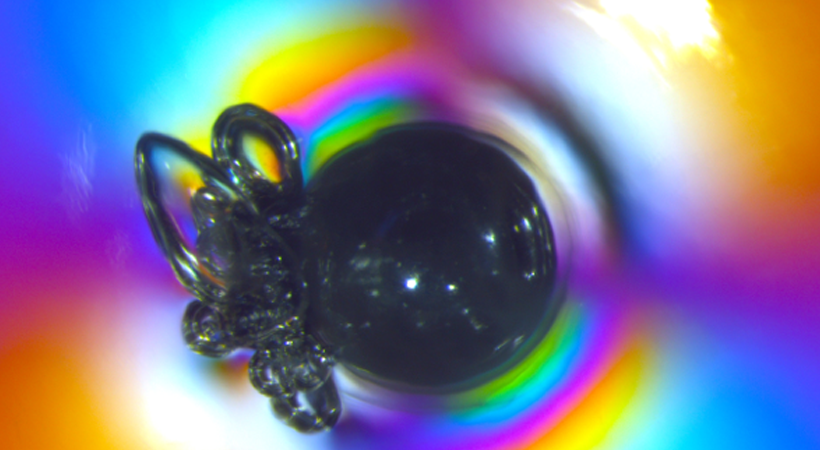
For example, a laboratory melt revealed colour streaks and large, round silicon inclusions containing high levels of lead, silver, and even antimony.