


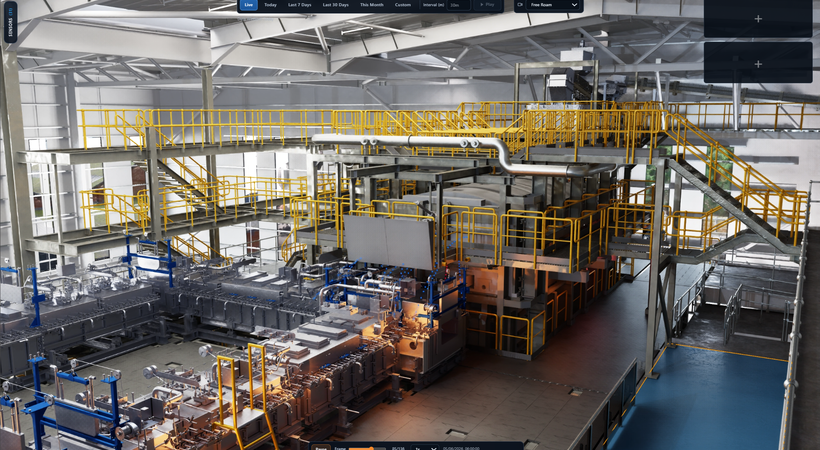
Glass Futures (GF) has developed an AI-driven glass furnace at its St Helens facility in Liverpool, UK.
The AI-Glass project uses a digital replica model of the company’s current multi-fuel pilot glass furnace.
The replica can test and predict the best and newest ways to make glass.
It combines data from the ‘real’ furnace and simulated information with the laws of physics, can process over 11k calculations at once and accurately predict glass output.
Dr Jim Scotson, project lead for industrial digitalisation at Glass Futures, said: “The digital twin enables us to test things industry has never tried out before.
“It means we can drive innovation by allowing manufacturers of glass and other materials to try new fuels, electric heating, bubbling and other techniques and get an accurate prediction of how the end product will turn out.
“Rather than just learning from our real and simulated data, the twin already has a physics informed neural network.
“When we put data in, it digests this with physics principals, meaning it’s incredibly accurate and can calculate 11,530 calculations all at once.
“This allows us to remove the barriers to experimentation by making things possible, more quickly.”
Glass Futures’ development of the digital replica means that the industry will be able to test changes in temperature, pressure, density and other measures on the digital furnace, which will accurately predict how this would work in a real furnace.
Glass Futures has been working with Nvidia, an artificial intelligence company, on the project for the last year.
The company has also collaborated with the University of Liverpool’s Virtual Engineering Centre, which has created a fully immersive model viewed through VR headsets.
By creating an exact replica of a real furnace, it means industry can be more experimental, testing new ways to decarbonise, improve efficiencies and confidently adopt new low-carbon alternatives such as hydrogen and biofuels.
Anthony Hills, Regional Director of UK&I at Nvidia, said: “AI-Glass shows how advanced AI can unlock entirely new ways of understanding and improving complex industrial processes.
“By combining Nvidia’s accelerated computing with physics-informed modelling, Glass Futures is turning data into actionable insight at unprecedented scale.
“This kind of capability allows industries to move faster, experiment with confidence and make smarter decisions as they work toward more sustainable and efficient production.”
Glass Futures plans to work with its members and cross-industry partners in steel, ceramics and other sectors on projects using the digital twin and then the real pilot line, as well as using their expertise to support other teams to digitalise.
Dr Scotson added: “This project wasn’t without its challenges.
“When we talk about flame shape and know just by looking at it how the furnace is performing, how do you describe pointy, jagged or flat to a computer?
“We solved this via temperature measurement, but we’ve learnt so much that we now want to support others with their digital, AI-driven projects.
“It might not be about a complete digital twin but how we can support them to take analogue information, digitalise it and use AI and modelling to extend the life of existing equipment.”
AI-Glass is part of a wider £1.5m Innovate UK funding programme being delivered through Make UK.
