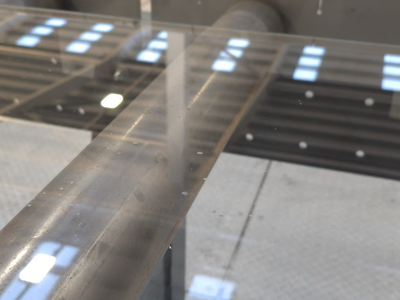
![IRIFIO is the first cold trial to take place on Glass Futures' pilot line at its facility in St Helens, UK. [Image: Courtesy of Siemens]](/imager/news/284449/Glass-Futures-WEB_2025-05-27-113119_lncn_46527c80523046a5c0b3b8e30581599a.png)
i3D Robotics has completed its research project to improve defect detection in glass manufacturing, highlighted by a successful trial at Glass Futures’ UK pilot facility.
The project, titled 'Intelligent Robotic Inspection for Foundation Industry Optimisation' (IRIFIO), aims to enhance productivity, reduce waste, and support net zero targets.
It leverages smart vision and sensory technology to detect tiny defects during the flat glass production process.
The project was the first cold trial to take place on Glass Futures' pilot line at its facility in St Helens, UK.
By simulating a flat glass production line, vision sensors identified microscopic defects during production, which were smaller than the 150 microns existing scanners can detect, and far beyond what manual inspection can spot.
Current defect detection methods, such as heat soaking, are also energy intensive and time consuming.
Implementing this solution could save toughened glass suppliers around £1.8 million by eliminating the heat soaking process, and preserve 11,000m³ of glass that would otherwise be discarded as false positives.
The technology also has the potential to reduce the flat glass industry's CO₂ emissions by 20,000 tonnes per year.
Dr Daniel Backhouse, Senior Glass Technologist at Glass Futures, said: “I'm proud to share that we successfully completed the first cold trial on Glass Futures' pilot line for the IRIFIO project.
“It was an exciting process, moving samples under the IRIFIO camera system to see how it performs in industrial conditions, and we gathered valuable data that our project partners will now analyse.
“We look forward to continuing to collaborate with our partners to further develop and scale this technology for the glass industry.”
In the glass industry, even the smallest imperfections can lead to substantial costs, and a tiny inclusion can cause a glass panel to shatter.
This project introduces a solution for faster, consistent, and more accurate inspections using machine learning and robotics.
The project received a collective £4 million in funding by UK Research and Innovation’s (UKRI) Transforming Foundation Industries (TFI) challenge and the TFI Fast Start competition.
It was managed by Science and Technology Facilities Council Hartree Centre, who also analysed the data.
Other collaborators include glass manufacturing supply chain consultants Glass Technology Services, and international materials consultancy Lucideon to explore similar advancements in not only glass, but ceramic production processes as well.