


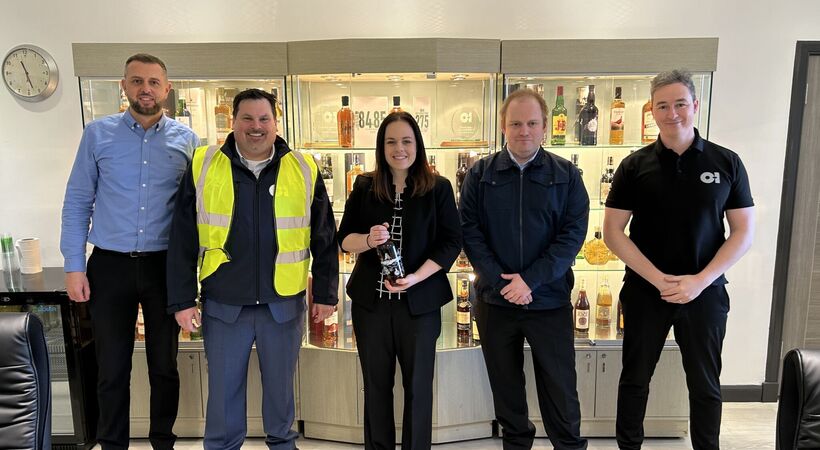
O -I Glass welcomed Scotland’s Deputy First Minister Kate Forbes to its Alloa plant to see the company’s investment in sustainable manufacturing.
First opened 275 years ago, the site remains a cornerstone of the local economy, employing around 500 people and producing more than 460 million bottles each year for major customers, including the Scotch Whisky Industry.
Today, that 275-year heritage is being carried into the future through O-I Glass’s £150 million investment in new technology.
During the visit, the Deputy First Minister toured the site’s newly rebuilt furnace and a second all-new furnace featuring energy-efficient technology.
The Deputy First Minister also heard about O-I’s role in supporting a circular economy through recycling and reuse, and how the proposed EPR scheme could create disproportionate costs for glass producers and encourage switching to less sustainable materials.
She met with employees and learned how O-I’s partnerships with local schools and workforce organisations are building the skills needed for Scotland’s future manufacturing sector.
Deputy First Minister Kate Forbes said: “Using technology which is the first of its kind in Scotland, O-I Glass is leading the way in sustainable glass production.
"This is a great example of how Scotland’s manufacturing sector is driving innovation to deliver a green future.
“The Scottish Government provided £1.4 million through our Scottish Industrial Energy Transformation Fund towards the conversion of a furnace which reduces carbon emissions by more than 7000 tonnes per year.
“The company’s longstanding commitment to Alloa, and its recent investment of more than £150 million at the site, is not only vital to local jobs but serves Scotland’s multi-billion pound food and drink sector which is central to our economy.”
Anthony Williams, UK Managing Director, said: “We’re proud to welcome the Deputy First Minister to Alloa to see the progress we’ve made through this major investment.
"The new furnace represents the next generation of glass manufacturing – improving efficiency, cutting carbon, and securing the long-term future of glass production in Scotland.
“It also strengthens our role in Scotland’s circular economy, ensuring that glass continues to set the standard for sustainable, infinitely recyclable packaging.”
