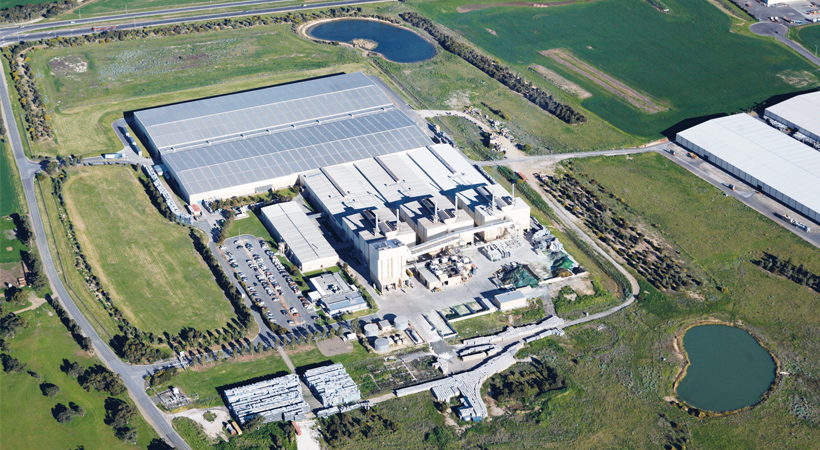
Orora will close the first of two glass furnaces in its portfolio in a few weeks.
The glass manufacturer confirmed it will close its Gawler G1 furnace in South Australia in September.
It also said the F4 furnace in its Le Havre facility, France will close next year.
In response to ongoing challenging conditions across the global glass industry, Orora undertook a review of its glass production network.
As previously reported, the Gawler facility will transition from three furnaces to two.
The commercial wine market in Australia remains in structural decline, which led to the decision to close the furnace.
Furthermore, plans are underway to close the F4 furnace at Le Havre in France, transitioning the site to a single furnace operation.
All European wine and champagne bottle production will be consolidated to the Ghlin site in Belgium, with a rebuild of the site’s furnace to be completed by July 2026.
These changes reflect decisive action taken by Orora to adjust its production network to reflect market demand, with flexibility to increase capacity when market conditions improve.
Brian Lowe, Managing Director and CEO of Orora, said: “Within our Global Glass business, the Saverglass business reported EBIT of €79.2m, down 5.5% compared to the prior corresponding period on a pro-forma basis.
“Our Gawler glass facility reported EBIT of $25.4m, a decrease of 54% which reflects the structurally challenged commercial wine market in Australia as well as the impact of the G3 furnace rebuild.
“This was higher than initially expected, due to the complexity of work required and equipment and weather delays.”
The added complexity of the G3 rebuild and construction of the oxygen plant increased the total capital cost to $184m.
Revenue
In its latest financial release for the year ending 30 June 2025, Orora achieved a 24.4% increase in revenue, which totalled $2.1 billion.
This reflected 12 months of contribution from Saverglass, compared to seven months in the prior corresponding period, as well as strong volume growth in its Cans sector.
Statutory net profit after tax (NPAT) was up by 425.4% at $973.1m, including net profit from discontinued operations and significant items.
EBITDA was $418.8m, up by 19.4%.
In addition, the group completed the divestment of its Orora Packaging Solutions (OPS) business in December 2024 for $1.8 billion.
Mr Lowe said: “Orora delivered a solid result over the past financial year as we completed the strategic transformation of our portfolio, with the divestment of OPS marking the final step in our journey to become a focused beverage packaging manufacturer.
“This was achieved despite ongoing challenges in the global operating environment, particularly around tariff implementation and consumer demand.”
Sustainability
Orora made strong progress across its sustainability agenda in FY25.
The Gawler site achieved 59.5% recycled content in its glass bottles manufactured in FY25, and is on track to achieve its target of 60% by the end of CY25.
The site also achieved a 30% improvement in emissions due to the oxygen plant installed as part of its G3 furnace rebuild.
The Global Glass Business (representing Saverglass and Gawler) achieved 44% recycled content for colour glass.
The group achieved a 19% reduction in Scope 1 and 2 greenhouse gas emissions in FY25 from an FY19 baseline for market-based factors, and a 22% reduction for location-based factors.
New sustainability targets have been set to encompass goals at group level, as well as for Global Glass and Cans.
Circular economy targets include 68% recycled content for colour glass beverage containers by FY35.
At a group level, climate change targets including 41% reduction in Scope 1 and Scope 2 greenhouse gas emissions by FY35 from at FY19 baseline.
In addition, for the first time, Orora has set a target for Scope 3 greenhouse gas emissions, with 31% reduction by FY35 from an FY25 baseline.
Orora will also continue to expand its cullet sourcing programme, particularly in Australia for container deposit schemes.
Global glass business
FY25 financial highlights (excluding significant items such as the Le Havre F4 furnace closure) included a revenue of $1,313.3m (33.1% increase) and an EBITDA of $300.1M (29.1% increase).
For the Gawler site, volumes were broadly in line with continued softness in commercial wine and beer offset by new products including food jars.
The ongoing softness in beer volumes has been caused by a shift in format towards aluminium cans, which has seen a strong volume growth in Orora’s cans sector.
Saverglass saw volumes decrease by 12% compared to FY24, which predominantly reflects the ongoing softness from global de-stocking, particularly in Europe.
However, volumes improved in the second half with growth of 9% compared to H1 2025.
FY26 Outlook
For Saverglass, EBIT is expected to be broadly in line with FY25.
Volume growth and cost reduction initiatives are expected to support higher EBITDA despite a continuation of the mix shift towards lower priced wine and champagne bottles.
This EBITDA growth is expected to be offset by higher depreciation.
For Gawler, EBIT is expected to be approximately $30m with the operational and financial benefits from the transition to a two-furnace operation being partially offset by higher depreciation.
This results in group EBITDA and cash flow growth for all businesses, which is expected to be partly offset by additional corporate costs previously allocated to OPS, and with higher depreciation, group EBIT growth will be tempered for FY26.
This outlook is subject to global and domestic economic conditions, currency fluctuations, and assumes no further changes to US tariffs.
Mr Lowe said: “With market-leading positions in cans, premium and luxury spirits, and wine packaging, and with an efficient and well calibrated footprint, we enter FY26 with cautious optimism and are well positioned for growth.”