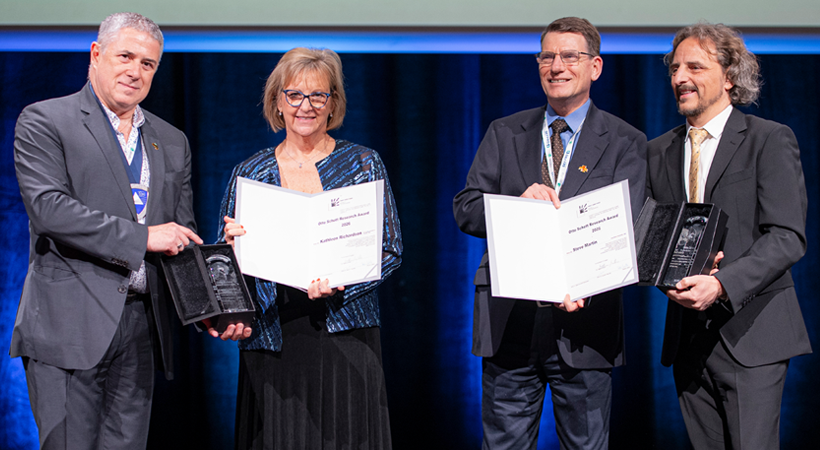
Dr Steve Martin and Dr Kathleen Richardson have received the 2026 Otto Schott Research Award.
Their work on the structure of glass, as well as optical and infrared materials, forms the basis for applications in fields such as healthcare, energy, electronics, and security and defence.
The award highlights scientific breakthroughs that pave the way for new materials and next-generation technologies.
Dr Martin, professor at Iowa State University, is recognised for his fundamental research on the structure of silicate and non-oxide glasses.
His work demonstrates how atomic structure determines key properties of glass, such as resistance to high temperatures, chemical exposure, and long-term stress.
This understanding is essential for developing specialty glass tailored to demanding applications, including pharmaceutical packaging and energy-intensive industrial processes.
Meanwhile, Dr Richardson, professor at the University of Central Florida’s College of Optics and Photonics (CREOL), is honoured for her contributions to the development of optical glasses and infrared materials.
Her research focuses on how precisely engineered compositions can control and transmit light.
This is particularly important for high-performance applications in infrared optics and sensing systems.
Dr Matthias Müller, Head of Research and Development at Schott, said: “The research of Steve Martin and Kathleen Richardson clearly shows how essential a deep understanding of material structures is for technological progress.
“These insights form the basis for developing new glass solutions that perform reliably in real-world applications and expand the boundaries of what is possible.”
The award, endowed with €25,000, was presented on April 13, 2026, during the annual meeting of the International Commission on Glass (ICG) in Lyon, France.
The presentation of the award by the Ernst Abbe Fund underscores the importance of linking scientific excellence with industrial implementation.
The goal is to translate research insights into scalable technologies and enable practical applications with societal impact.