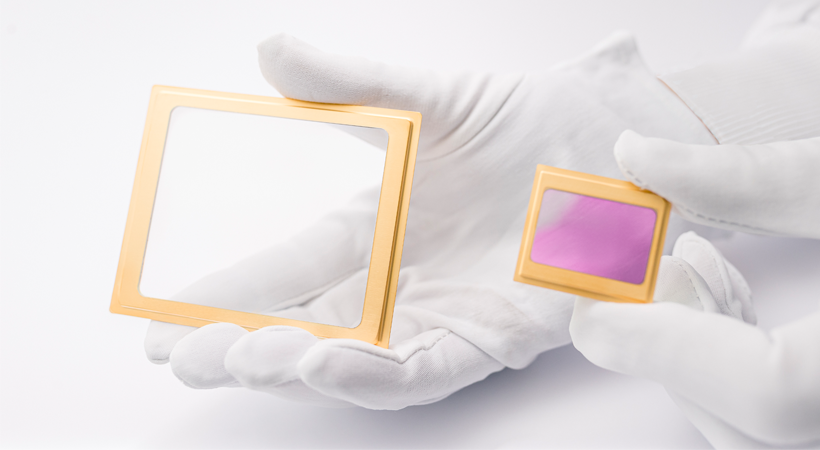
Schott has launched a line of high-tech ‘lids’ designed to protect the critical optical components that power the internet.
These lids feature large glass windows engineered to let light pass through with minimal interference.
By using larger windows, manufacturers can pack more Micro-Electro-Mechanical Systems (MEMS) into a single device.
This allows AI and cloud providers to scale up their hardware more efficiently using Optical Circuit Switches (OCS).
As demand for bandwidth grows, hyperscale and AI service providers are adopting OCS to future-proof their networks.
OCSs act like high-speed, reconfigurable train tracks for light in a data centre, allowing massive amounts of data to be directly routed between servers with minimal delay and power.
The prevalent OCS technology uses MEMS mirrors to create direct optical paths between fibres, enabling ultra-low latency, massive scalability, and energy efficiency.
Schott’s hermetic lids shield the sensitive MEMS components in these switches from moisture, dust, and particulate contamination, a fundamental requirement for device longevity.
With larger optical windows (up to 100 cm²), a single lid can protect and seal MEMS arrays containing significantly more mirrors.
This enables higher port counts and switching capacity while keeping the footprint compact.
Robert Hettler, R&D Head at Schott’s Hermetic Packaging Division, said: “The evolution towards higher radix, all-optical switching is fundamental to supporting AI workloads.
“Our OCS MEMS lids are a foundational component in this shift. By providing a larger, clearer, and perfectly sealed optical window, we allow OCS designers to integrate more mirrors, pushing the boundaries of switch scale and performance.”
Fabricated from high-precision optical glass, Schott hermetic MEMS lids eliminate optical birefringence, a phenomenon that can distort signal integrity in high-precision systems and is common with crystalline materials like sapphire.
Optical glass provides an isotropic, amorphous structure for consistent refractive index in all directions.
Glass also provides an optimal balance of high performance and manufacturability, delivering value without compromising on optical clarity or hermetic reliability.
In addition, the company can customise hermetic lids in various form factors and shapes for other applications, including sensing and AR/VR light engines.